
Held At Gunpoint
I was held up at gunpoint in Costa Rica. Actually, it was three gunmen, but one is enough, right?
Truthfully, that wasn’t a one-off. Living in the jungle, I saw a lot of crime — I’m in double figures for robberies; I was mugged, stalked, and I saw more death than I ever thought possible for a West Sussex girl. Out there, that was normal. And when something is normal, you adapt to survive it. Not always in the healthiest ways.
What I didn’t realise at the time was that my nervous system was adapting too — learning to stay switched on, just in case. Even now, years later and an ocean away, if I’m walking somewhere at night, I’m checking behind me. In most situations, I read the people around me and anticipate risks before I’ve consciously decided to. It doesn’t stop me from going out. But my nervous system never fully stood down from those years — it’s still calibrated for a threat that, on a normal Tuesday night in the UK, isn’t actually there.
It’s a pattern I see constantly in my work: stress and gut symptoms, especially in perimenopause, showing up together, often years after whatever first wired the alarm.
Living On High Alert
Here’s the thing that surprises most people: your nervous system doesn’t need a gunman or a decade in a high-crime jungle town to fire that same response. Job uncertainty. Money worry. A relationship under strain. None of these are gunpoint situations — but chemically and physiologically, your body runs an almost identical reaction. Same alarm system, cascade of hormones and that all-hands-on-deck response, whether the threat is a man with a weapon or an inbox you’re dreading opening.
That’s not a flaw in the system. It’s how the system was built — react first, work out the details later. The problem is what happens when that system doesn’t get the “stand down” signal, over and over, for months or years at a time.
Checking Behind Me
The threat doesn’t have to be real for your body to react.
The Alarm That Won't Switch Off
Your nervous system has a built-in stress response, run by something called the HPA axis — the pathway between “something feels threatening” and the physical reaction that follows1 .
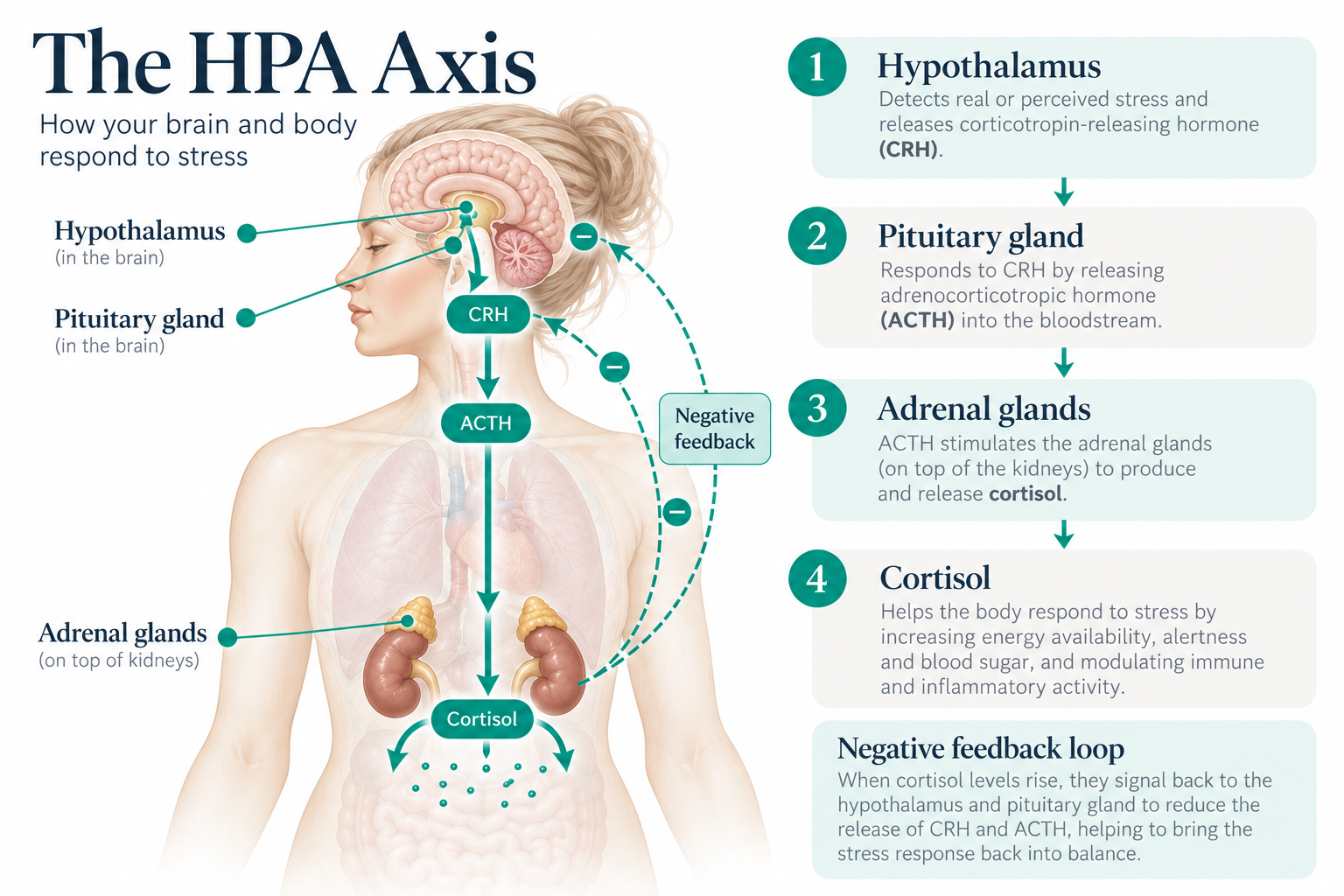
Think of it as a smoke alarm.
A well-calibrated one only goes off when there’s real smoke. But an alarm that’s been triggered again and again — genuinely dangerous smoke or not — can become oversensitive. Eventually it’s going off at toast.
When your HPA axis keeps firing without enough recovery time in between, the wear starts to build faster than your body can repair it — a concept known as allostatic load2. It’s not one big stressful event that does the damage. It’s the accumulation — the alarm never quite resetting before the next trigger. This was actually the theme of my breathwork class back in July — it comes up more than people expect once they start looking for it.
The Oestrogen Connection
Oestrogen plays a regulating role in your HPA axis3 — it has a dampening effect on how strongly your body reacts to a stressor, and how efficiently it brings things back down afterward. As oestrogen declines through perimenopause, that regulating effect declines with it. You’re not necessarily facing more stressful events. Your alarm may simply be quicker to trigger, and slower to switch off.
This is a different mechanism to the one I wrote about back in June, when we looked at the estrobolome — how your gut microbiome helps regulate oestrogen directly. This is oestrogen working the other way: through your stress response, not your digestion. Two separate pathways, same hormone, and worth knowing both.
Where the Problem Lands
Stress and Gut Symptoms in Perimenopause
An alarm that won’t reset doesn’t stay contained to how you feel emotionally. Your gut is wired directly into this stress response — motility, sensitivity, and the integrity of your gut lining can all be affected when that system stays activated4. This is often where allostatic load becomes visible, even when nothing about what you’re eating has changed.
If your gut has been unpredictable through this stage of life and nothing you’ve changed with food has settled it, this may be one possible piece of the picture worth exploring.
Build Up, Not Broken
Allostatic load is years of strain with no recovery in between
A Practical Tool to Try Today
You can’t argue your alarm system down with logic. But you can send it a physical signal that it’s safe to stand down — and one of the simplest is extending your exhale.
Breathe in for a count of four. Breathe out for a count of six to eight — longer than the in-breath. Repeat for two minutes. The longer exhale activates your parasympathetic nervous system — the part responsible for rest and recovery — and gives your body a direct, physical reason to lower the alarm, rather than waiting for the feeling to pass on its own.
But the real takeaway isn’t this one technique. It’s not undone by one deep breath when things spiral — allostatic load doesn’t build from a single bad day, it builds from years of always-on, no real recovery in between. What actually shifts it is doing something small, briefly and often: two to five minutes, one to three times a day, done consistently rather than only when you remember or when things get bad.
This is exactly what I talked about back in June at the Kent Wellness Festival and in my June blog post Does Stress Cause Bloating — breathwork isn’t just a stress-in-the-moment tool. Done regularly, it builds real resilience, the kind that changes how reactive your system is in the first place.
Where To Go From Here
If stress and gut symptoms in perimenopause sound familiar, you don’t have to work it out alone. A free Gut Conversation is the place to start — we’ll look at your whole picture, not just your gut in isolation, and figure out where to focus first.
And if you’re reading this on behalf of a man in your life, or you’re a man reading it yourself — this isn’t only a midlife-women’s story. Next month, for Movember, I’m looking at why the same alarm system shows up in men just as much, and why it’s rarely talked about.

Photograph by Violeta Orlauskaite
References
- Ring, M. An Integrative Approach to HPA Axis Dysfunction: From Recognition to Recovery Science Direct, 2025.
- Guidi J, Lucente M, Sonino N, Fava GA. Allostatic Load and Its Impact on Health: A Systematic Review PubMed/Karger, 2021.
- Hantsoo L, Jagodnik KM, et al. The role of the hypothalamic-pituitary-adrenal axis in depression across the female reproductive lifecycle: current knowledge and future directions. Frontiers in Endocrinology, 2023.
- Marwaha K, Cain R, Asmis K, et al. Exploring the complex relationship between psychosocial stress and the gut microbiome: implications for inflammation and immune modulation. Journal of Applied Physiology, 2024.
Jungle-Trained. Science-Informed.
Photograph by Violeta Orlauskaite
Nikkie Windsor UKIHCA-RHC
Integrated Nutritionist & Breath Coach
Gut issues stealing your freedom? I help mid-life adults get to the root of unpredictable digestion, stress-driven symptoms, and low energy — through nutrition, nervous system regulation, and breathwork.
I live with Crohn’s disease, so I know what it means to plan your life around your gut. And I know what it takes to stop.
Book a free Gut Conversation to explore your symptoms and map out your next steps.
Photograph by Violeta Orlauskaite
Nikkie Windsor UKIHCA-RHC
Nutritionist, Health Coach & Breathwork Facilitator
Jungle-Trained. Science-Informed.
I help people navigating midlife move from gut chaos, low energy and overwhelm to steady digestion, resilient energy and confidence in their bodies again.
Book a personalised strategy call to explore your gut symptoms, energy and stress patterns — and map out your next steps.
Are You Ready to Change Your Gut Story?
You don’t have to manage this alone. Take the first step to feeling better today.